At the Endocrine Society of Australia (ESA), we are proud to bring together a vibrant community of over 1000 members, spanning both pioneering clinicians and innovative basic science researchers. Central to our mission is the commitment to nurture and shape the next generation of endocrinologists and health professionals.
Our ESA Mentorship Program (ESAMP) is a cornerstone of this mission, offering a dynamic and supportive framework for professional growth. By connecting emerging talents with experienced mentors, we create opportunities for meaningful development, career advancement, and innovative collaboration.
ESA Mentorship Program Goals
Foster Professional Development: Provide targeted guidance and support to help mentees advance their careers in endocrinology, whether in clinical practice, research, or academic roles.
Enhance Integration of Disciplines: Promote collaboration between clinicians and basic science researchers, facilitating the exchange of knowledge and bridging the gap between clinical practice and scientific research.
Support Personal Growth and Work-Life Balance: Address challenges related to work-life balance and personal development, ensuring mentees can thrive both professionally and personally.
Encourage Networking and Collaboration: Build a strong network of professionals within the ESA community, enabling mentees to connect with experienced mentors and peers.
Prepare Future Leaders: Equip mentees with the skills, insights, and experiences necessary to become leaders in the field of endocrinology and contribute to advancements in healthcare.
About the Program
ESAMP is an initiative of the 2024 ESA Early Career Committee (ECC), designed to support and guide emerging professionals in the field of endocrinology. We are excited to invite both experienced professionals and emerging talents to participate in our Mentorship Program. Mentors will have their profiles featured on the ESA website in a members-only section, showcasing their expertise and areas of interest. Mentees are encouraged to review these profiles and reach out to potential mentors to explore and establish mentorship relationships that align with their career goals.
The ESA’s role is to provide a dynamic platform for connecting mentors and mentees, but the responsibility for initiating and managing these relationships rests with the participants. Self-matching allows for a more tailored and beneficial mentorship experience, as it enables both parties to find the best fit based on their specific needs and goals.
Advice provided and discussions held between the mentor and mentee must be kept confidential and not disclosed to any third party, unless mutually agreed by the mentor and mentee. Any advice, comments, suggestions, opinions or information (in either individual or combined occurrence) imparted (verbally, in written or electronic correspondence, or by a combination of these) are given with the best intentions and according to the best knowledge of the mentor involved. Whilst every care is taken to deliver accurate and complete advice, comments, suggestions, opinions or information (in either individual or combined occurrence), no liability whatsoever attaches to the mentor nor to ESA in any way as a result of giving that advice.
Benefits for Mentors
Benefits for Mentees
Professional fulfillment
Expand professional network
Knowledge exchange
Leadership development
Recognition and visibility
Personal growth
Impact in the field
Career development
Expert advice
Skill enhancement
Networking opportunities
Personal growth
Increased confidence
Access to resources
For Mentors
We are delighted to invite experienced clinicians and researchers to contribute to the professional development of emerging endocrinologists or researchers now.
As a mentor, you will play a pivotal role in shaping the future of the field by providing valuable guidance and support.
Eligibility to be a Mentor
To qualify as a mentor within the ESA Mentorship Program, individuals must meet the following criteria:
All mentors must be current members of the ESA; AND
Clinician members must have completed their Fellowship of the Royal Australasian College of Physicians (FRACP) and have a minimum of one year of post-FRACP experience; OR
Basic science members must hold a PhD degree.
These eligibility requirements ensure that all mentors bring a high level of expertise and professional experience to the program.
Benefits for Mentors
Professional Fulfillment: Experience the satisfaction of shaping the careers of emerging professionals.
Networking Opportunities: Expand your professional connections.
Knowledge Exchange: Stay current with emerging trends through discussions with mentees.
Leadership Development: Enhance your leadership and coaching skills.
Recognition and Visibility: Gain recognition within the ESA community.
Personal Growth: Gain new perspectives through the mentorship process.
Impact in the Field: Contribute to the advancement of endocrinology.
To assess your readiness, please review the following self-checklist:
Are you ready to be a mentor checklist:
I have a sincere interest in helping juniors to succeed.
I am willing to use my network of contacts to help my junior.
I have the access to the kind of opportunities that can support the juniors learning.
I am the right person to help the junior to achieve his/her goals.
I can commit adequate time to mentor in a meaningful way.
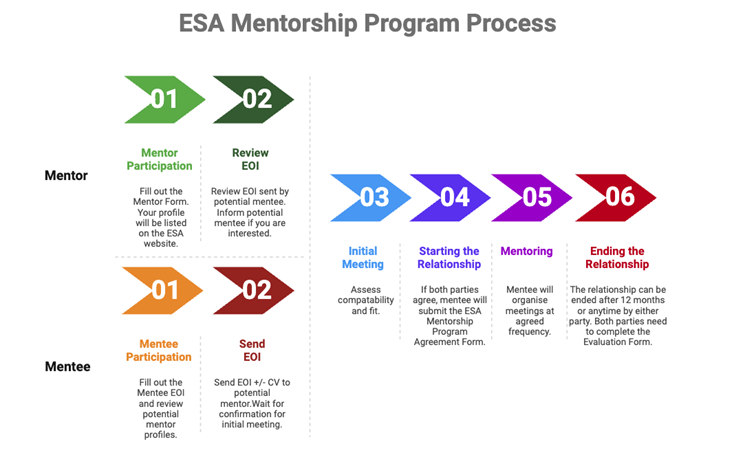
For comprehensive guidelines, refer to the Mentor Handbook. To formalize your participation, complete the Mentor Expression of Interest Form. Your profile and contact information will be uploaded to a members-only section of the ESA website. The mentor retains the final decision on whether to schedule an initial meeting to assess compatibility.
Thank you for contributing to the growth and development of future endocrinologists.
For Mentees
We are excited to support your professional growth by connecting you with experienced mentors. Mentee recruitment is anticipated to start in 2025. Stay updated for more information!
As a mentee, you have the opportunity to benefit from the expertise of seasoned professionals in endocrinology.
Eligibility to be a Mentee
To participate in the ESA Mentorship Program as a mentee, individuals must meet the following criteria:
All mentees must be current members of the ESA; AND
Clinician members must be at least at the stage of an Endocrinology Advanced Trainee; OR
Basic science members must have completed their basic science degree.
These eligibility criteria ensure that mentees are suitably prepared for a meaningful and productive mentoring relationship.
Benefits for Mentees
Career Development: Receive personalized guidance to achieve professional goals.
Expert Advice: Gain valuable insights from experienced mentors.
Skill Enhancement: Develop key skills and competencies.
Networking Opportunities: Expand your professional network.
Personal Growth: Get support in managing work-life balance and challenges.
Increased Confidence: Build confidence through constructive feedback and encouragement.
Access to Resources: Gain access to industry insights and career advancement strategies.
To assess your readiness, please review the following self-checklist:
Are you ready to be a mentee checklist:
Have you identified specific goals or objectives you hope to achieve through mentorship?
Do you have a clear understanding of your strengths, weakness, and areas for development in your professional career?
Are you prepared to communicate openly and honestly with your mentor about your challenges, concerns and progress?
Are you open to receiving constructive feedback and guidance from a mentor?
Are you willing to commit time and effort to actively engage in mentorship activities and following through on agreed-upon action plans?
Mentees can explore potential Mentor Profiles. If you find a mentor who aligns with your interests, please complete this Mentee Expression of Interest Form and email the potential mentor directly. Including a brief CV is strongly encouraged. The mentor retains the final decision on whether to schedule an initial meeting to assess compatibility. An EOI does not guarantee a successful match.
Establishing the Mentorship Relationship
1. Initial meeting to assess compatibility and fit
The initial meeting is essential for assessing compatibility. To ensure a productive relationship, consider the following:
Mutual Interest and Compatibility: Ensure both parties are genuinely interested and compatible with each other's professional goals.
Congruent Assumptions and Expectations: Discuss and align on the assumptions and expectations about the mentorship process.
Matching Needs with Strengths: Confirm the mentee’s needs align with the mentor’s strengths and expertise.
If these criteria are met, you can proceed to establish the mentorship relationship with confidence.
2. Agreement to enter mentor-mentee relationship
Once both parties agree to proceed, mentees must complete and submit the ESA Mentorship Program Agreement Form. The mentorship is initially established for a 12-month period, but both parties have the flexibility to terminate or extend the relationship as needed.
Both mentors and mentees are responsible for scheduling and managing their meetings according to the agreed frequency and time.
3. Effective mentoring meetings
To ensure productive and impactful meetings, consider these guidelines:
Set Clear Objectives: Begin each meeting with a clear agenda.
Prepare in Advance: Both parties should come prepared with relevant materials and questions.
Maintain Open Communication: Foster an environment of open and honest communication.
Review Progress: Regularly review progress towards goals.
Set Actionable Next Steps: Conclude each meeting by outlining specific tasks and deadlines.
Document Discussions: Keep a record of key points, decisions, and action items.
Evaluate and Reflect: Periodically evaluate the effectiveness of the mentorship.
Mentees are strongly encouraged to keep a record of their mentor meeting minutes using the provided templates (for personal use only, not monitored by ESA):
At the conclusion of the 12-month period, or sooner, either party may choose to end the relationship. Both parties must complete the End of Mentorship Program Evaluation Form to provide feedback.
The relationship can be extended beyond 12 months at the discretion of both parties. The mentee will need to complete a new Mentor Agreement Form to formalize the extension.
Complete the relevant Mentor Agreement Form. Mentees will browse your profile and submit Expressions of Interest (EOI).
How does the initial meeting work?
After reviewing a mentee’s EOI, you decide if you wish to have an initial meeting to assess compatibility and discuss expectations before agreeing to proceed.
What is the duration of the mentoring relationship?
It is initially set for a 12-month period, but can be terminated early or extended by mutual agreement.
How often should meetings occur?
Mentors and mentees agree on the frequency and timing of meetings. The mentee typically takes the lead in scheduling.
Can I have more than one mentee?
Yes, but you must ensure you can provide adequate time and attention to maintain the quality of each relationship.
What if I no longer wish to accept more mentees or decide to discontinue my role?
Notify the ESA mentorship program coordinators as soon as possible. Your profile will be marked as "unavailable" or removed.
How do I handle challenges in the mentoring relationship?
Address challenges openly and constructively. If the relationship is not working, communicate openly and consider ending it.
What should I do if I need to end the mentorship relationship early?
Inform your mentee as soon as possible and complete the End of Mentorship Program Evaluation Form.
Will negative feedback impact my standing in the ESA or the Mentorship Program?
No. Feedback is used to identify areas for improvement and enhance the program.
Can I apply to be a mentor and also seek mentorship from others?
Yes, you can hold a dual role, but manage your time and commitments effectively.
Browse the profiles of available mentors on the ESA website. Complete the Mentee Expression of Interest Form and contact the potential mentor directly. Including a brief CV is strongly encouraged.
How do I prepare for the initial meeting with my mentor?
Outline your goals, interests, and expectations. Prepare questions to assess compatibility and be ready to discuss your career aspirations and challenges.
What is the duration of the mentoring relationship?
It is initially set for a 12-month period, but can be terminated early or extended by mutual agreement.
How often should meetings occur?
Mentors and mentees agree on the frequency and timing of meetings. The mentee typically takes the lead in scheduling.
Is it mandatory to send my Mentoring Action Plan to the ESA?
No. The Mentoring Action Plan is for your personal record and can be shared with your mentor, but not the ESA coordinators.
Can I have more than one mentor from the program?
Yes, having multiple mentors can offer diverse perspectives, but you must manage the time commitment effectively for each relationship.
How do I handle challenges in the mentoring relationship?
Address challenges openly and constructively. If the relationship is not working, communicate openly and consider ending it.
What should I do if I need to end the mentorship relationship early?
Inform your mentor as soon as possible and complete the End of Mentorship Program Evaluation Form.
Will negative feedback impact my standing in the ESA or the Mentorship Program?
No. Feedback is used to identify areas for improvement and enhance the program.
Can I apply to be a mentee and also mentor others?
Yes, you can hold a dual role. Manage your time effectively to ensure both experiences are fulfilling.